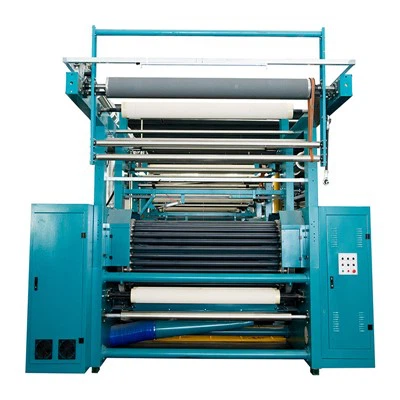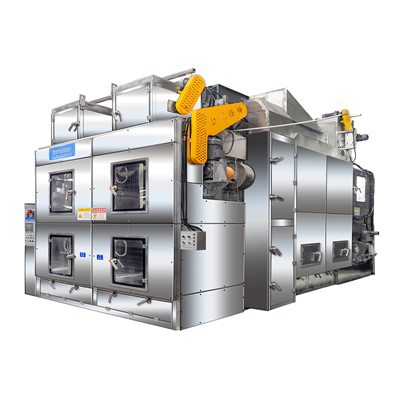
A needle punching machine is a blanket-forming device that compacts and needles a refractory fiber blanket blank of a certain thickness to form a refractory fiber blanket. It utilizes needles with triangular or other shaped cross-sections and barbs on their edges to repeatedly pierce the fiber web. The fiber web from a cross-linked or air-laid web forming machine is very loose when fed into the needle punching machine, possessing only a certain strength generated by the cohesion between fibers, but this strength is very weak. When multiple needles pierce the fiber web, the barbs on the needles cause the fibers on the surface and subsurface of the web to move from the planar direction to the perpendicular direction of the web, causing the fibers to shift vertically. This vertical displacement of the fibers exerts a certain amount of pressure on the web, causing the fibers within the web to clump together and be compressed.
Once the needle reaches a certain depth, it begins to rise. Due to the directional orientation of the hook, the displaced fibers detach from the hook and remain in the web in an almost vertical state, much like many fiber bundles being driven into the web as "pins." This prevents the web from recovering from compression. If the web is repeatedly pierced dozens or hundreds of times per square centimeter, a considerable number of fiber bundles are driven into the web. This increases the friction between fibers within the web, raising its strength and density. The web then forms a nonwoven fabric with certain strength, density, and elasticity properties.